The Hanging House
The Wind-Up Bird ChronicleThe Hanging House is a Setagaya residence that moves through the novel from ordinary family home to vacant property, feared local landmark, concealed political asset, and finally a demolished patch of earth. Its decisive significance lies in that transformation: the house seems to absorb the happiness and terror of its inhabitants, while its garden well becomes a physical route into darkness for Toru Okada. The story repeatedly tests whether a house can be trusted to preserve the people who made it a home—or whether it can outlast and disown them.
Setting and Physical Character
The property stands within a quiet residential neighborhood reached by a narrow passage that the locals call an alley, though it is neither a proper road nor a through-route. About two hundred yards long and barely more than three feet wide in places, the passage threads behind the houses between their gardens. A wall and a barrier close its ends; fences and discarded objects constrict the way further. It is not simply a convenient approach to the house but a secluded corridor, cut off from ordinary circulation and hemmed in by the private spaces of neighboring homes.
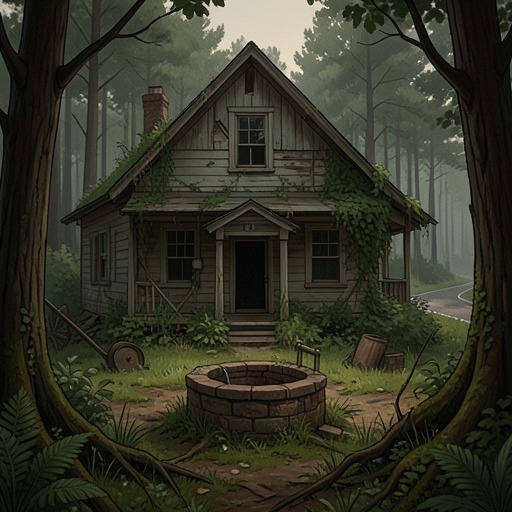
The empty house first appears as a fairly new two-story building whose exterior already suggests prolonged neglect. Its wooden storm shutters are severely weathered, the second-floor railings are rusted, and weeds overrun its small garden. At the center of that garden stands a stone bird statue on a chest-high base, its wings open as if poised to escape. Plastic lawn chairs lean against the house; bright-red azalea blossoms punctuate the weeds with a color that seems strangely unreal. The setting’s dissonance is specific: a domestic garden remains recognizable, but its decorative order has yielded to neglect, and the bird’s arrested flight gives that abandonment a stark emblem.
From Family Home to Vacant House
Before becoming a byword for misfortune, the house belonged to the Miyawaki family. In May Kasahara’s recollection, they seemed to live peacefully there: the family laughed together, the dog was part of the cheerful household, and the two daughters appeared kind. The contrast between that remembered domestic happiness and the house’s later reputation is central to its effect. Its eerie character does not begin as an obvious feature of its architecture; it emerges after the lives that gave the place meaning disappear.
The Miyawakis vanished with their German shepherd, leaving the house behind. Neighbors did not immediately realize they were gone; the darkened house was first explained away as the family being on a trip. When the disappearance became apparent, the property’s appearance seemed to change with it. May describes the abandoned building as strangely self-sufficient, as though it had no memory of its former occupants or of the care they had given it. Her anger at that apparent ingratitude turns the ordinary fact of an empty house into an unsettling question of memory and responsibility: a dwelling may have sheltered a family, yet appear to deny that the family was ever there.
The property’s private history becomes neighborhood legend. Locals call it the hanging house and say that everyone who lived there suffered misfortune and died by suicide, most by hanging. That account is presented as what people say about the house, not as a verified explanation of the Miyawaki family’s disappearance. Its force comes from its accumulation of rumor and dread: the structure becomes a place onto which the neighborhood projects a recurring pattern of catastrophe, even as the specific truth behind that pattern remains uncertain.
The House, the Alley, and the Well
The concealed garden well gives the property a role beyond that of a haunted-looking setting. When Toru visits the abandoned yard, he finds the well capped with stones and prepares to descend by rope ladder. He removes the stones and one of the wooden half-circles covering it, then drops a pebble to test the bottom. The sound is a dry thud: there is no water. He ties the ladder to a nearby tree and tests its hold, aware that if it comes loose he may not be able to return to the surface. The ladder disappears into the depth without his seeing it reach the bottom; even the flashlight beam is swallowed by darkness.
The preparation makes the well’s danger concrete. Toru does not enter an abstract symbol of the unknown but a specific, deep shaft in an abandoned garden, with an improvised means of escape secured above him. The house’s boundary spaces—the constricted alley, the overgrown yard, the sealed well—form a progression away from public life and into isolation. That descent also links the property’s present-day landscape to a wider pattern in the novel, in which the well becomes a place of exposure to darkness and a test of whether a person can endure being cut off from the surface.
Ownership, Secrecy, and the Residence
The name The Hanging House also appears in an investigative report about the property and its new owner. The report says that attempts to identify who acquired the lot met a brick wall at every turn. A construction company refused to provide information, while a dummy company that purchased the land was legally clean. The publication traces the company’s accounting arrangements to a shadow subcontractor associated with a prominent firm known in political circles, and infers that the new resident may be connected to a powerful politician. These are the report’s suspicions, not a fully established account of the owner’s identity.
The novel connects that concealed property to the Residence, the house in which Nutmeg Akasaka and Cinnamon Akasaka conduct their work. The Residence contains a fitting room made to match the one at the Akasaka office almost exactly: it has the same gloomy arrangement of two-layer curtains, a leather sofa, flowers in a glass vase, a floor lamp, a large workbench, sewing tools, a full-length mirror, and a curtained-off changing area. Its duplicate furnishings give the room the feel of a familiar professional space transplanted into a house. Toru feels a peculiar security among the dressmaking tools, although the setting remains unreal. The fitting room thus makes the Residence both a private home and a carefully reproduced work environment, an interior whose reassuring familiarity coexists with concealment.
That concealment becomes more consequential when magazine investigations and Toru’s brother-in-law’s involvement raise the perceived risk. Nutmeg tells Toru that she and Cinnamon have canceled all remaining client appointments, effective immediately, and will receive no clients until Cinnamon can repair the system’s vulnerabilities and they can be sure the crisis has passed. Cinnamon continues to come to the Residence each day, but the service itself is suspended. The decision shows how the house’s hidden business, guarded identity, and political exposure turn the apparently private property into a site where access and secrecy must be actively managed.
Demolition and the Meaning of the Site
The house eventually disappears. Toru returns in winter to find the yard enclosed by a high plank fence and the building demolished. Through the gaps he can see no paving stones, well, trees, television antenna, or bird sculpture—only flat, black earth compacted by bulldozer tracks and a few clumps of weeds. He can hardly believe that a deep well once occupied the lot. The clearing removes not just the house but the physical evidence that made its history accessible: its garden, its boundary objects, and the entrance to the darkness below.
The absence of the house coincides with the absence of May Kasahara from the neighboring home. Toru looks toward her second-floor room, but she is no longer there to greet him as Mr. Wind-Up Bird. The empty lot and the empty room create a quiet double disappearance: the property’s former structure and the familiar voice associated with its surroundings are both gone. The site’s final form does not resolve its mysteries. Instead, demolition sharpens the novel’s concern with how places hold memory and how easily their visible traces can be flattened, leaving a person to doubt that what once occupied the ground—and what happened there—was real at all.